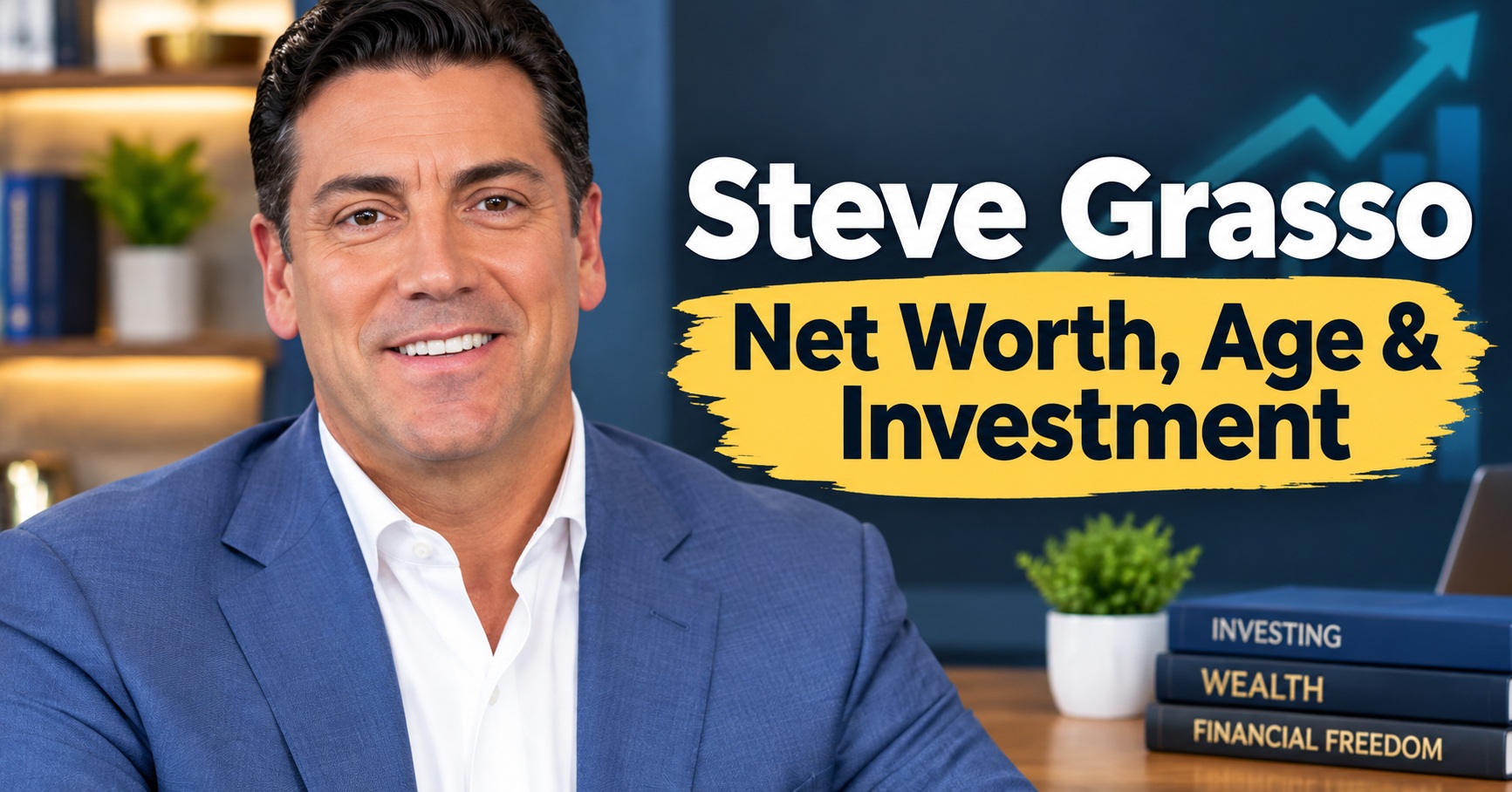
If you’ve watched CNBC’s Fast Money for more than five minutes, you already know the voice: calm, blunt, and never chasing a headline just to fill airtime. That’s Steve Grasso. People search for Steve Grasso net worth for a simple reason — they want to know whether decades on the trading floor and years on television actually add up to real money, or whether it’s just a guess floating around the internet. The honest answer sits somewhere in between. Grasso built his career the old-fashioned way, starting on the floor of the New York Stock Exchange in the early 1990s before moving into institutional sales trading and, later, financial media.
Steve Grasso Net Worth public figures, though, are estimates rather than confirmed numbers, since traders in his position rarely publish their finances. This guide walks through what’s actually documented about his career, his role at Stuart Frankel & Co., his run on CNBC, and what can (and can’t) be said about his wealth in 2026, so you’re not left relying on recycled guesses from random gossip sites.
Who Is Steve Grasso?
Steve Grasso is an American stock trader and financial television personality best known for his long tenure as a contributor on CNBC’s Fast Money. He’s spent most of his professional life on the institutional side of Wall Street rather than as a hedge fund manager or a retail-facing influencer, and that distinction matters. Unlike traders who build fortunes through proprietary bets or fund management fees, Grasso earned his reputation executing large block trades on behalf of pension funds, mutual funds, insurance companies, and hedge funds. His day job, in other words, runs quieter than his television persona suggests.
On air, he earned the nickname “The Governor” for his steady, measured delivery, particularly during volatile stretches when other commentators leaned toward drama. That reputation for composure under pressure is arguably his biggest professional asset, since financial television lives or dies on trust. Viewers keep coming back to hosts who don’t flinch when markets do.
It’s worth separating the two halves of his public identity here. There’s Grasso the institutional trader, whose work happens largely behind the scenes and isn’t something outsiders can verify in dollar terms. And there’s Grasso the media figure, whose visibility is easy to track through his CNBC appearances but which doesn’t, by itself, tell you much about his personal balance sheet. Both halves feed into any honest discussion of Steve Grasso net worth, and neither one gets you an exact number.
Steve Grasso Net Worth, Early Life and Background
Grasso’s early life is one of the least documented parts of his public profile, and that’s largely by design. He’s never built a personal brand around his upbringing the way some finance personalities do, and there’s no consistently verified public record of his exact birth year, hometown, or family background. What is consistently reported is that he’s an American who came up through Wall Street’s trading floor culture rather than through a hedge fund or investment bank training program, which was a fairly common path in the early 1990s.
That floor-trading background shapes a lot of how he talks about markets today. Traders who cut their teeth on the physical NYSE floor tend to think in terms of order flow, liquidity, and real-time positioning rather than abstract theory, and Grasso’s on-air commentary consistently reflects that instinct. He talks less about macro narratives and more about what the tape is actually doing.
Because so little of his early biography is independently confirmed, readers should treat claims about his birth date, family history, or childhood circumstances with some skepticism. Multiple low-quality sites report conflicting details — different birth years, different hometowns — which is a strong signal that nobody has actually verified the underlying facts. The safest general statement is this: Grasso built a career from the ground up on the trading floor, without the benefit of a widely publicized early life story, and his professional record from 1993 onward is far better documented than anything before it.
Education and the Path to Wall Street
Here’s where the record gets thin again. Grasso’s formal educational background isn’t publicly documented in any verifiable, consistent way, and several sites that claim to know his exact degrees and universities contradict one another. Rather than repeat unverified claims, it’s more useful to focus on what actually launched his career: hands-on floor experience.
Grasso began working on the floor of the New York Stock Exchange in 1993. That’s not a classroom credential, but for traders of that generation, it functioned as one. Floor trading in the 1990s meant learning the mechanics of price discovery in real time, reading order books, and understanding how large institutional orders moved markets, all skills that can’t really be taught from a textbook.
Six years later, in 1999, he joined Stuart Frankel & Co. as an institutional sales trader, a move that set the trajectory for the rest of his career. That’s the credential that actually matters for understanding his professional rise: not a diploma, but two decades-plus of direct market experience with some of the largest institutional players in the world.
Career Evolution and Rise on CNBC
Grasso’s career didn’t follow a straight line from trading floor to television studio. It evolved gradually, built on the kind of institutional credibility that takes years to earn. Before he ever appeared on a CNBC panel, he’d already spent close to two decades executing trades for major mutual funds, pension funds, and hedge funds, which gave him something a lot of financial commentators lack: actual skin in the market’s daily mechanics.
That real-world trading background is exactly what made him useful to CNBC’s producers. Financial television needs voices who can translate what’s happening on trading desks into language a broad audience understands, and Grasso’s floor pedigree gave him instant credibility with viewers who could smell inauthenticity from a mile away. He wasn’t a talking head reciting analyst notes; he was someone who’d actually worked the order flow.
Over time, his role expanded from occasional guest to a fixture of the Fast Money cast, and his commentary style — direct, occasionally blunt, rarely sensational — became one of the show’s more recognizable voices. He’s known for focusing on probability and risk-reward setups rather than dramatic predictions, a habit that’s kept him relevant through multiple market cycles, from the 2008 aftermath through the pandemic-era volatility and beyond.
Wall Street Trading Career
Grasso’s core professional identity remains, at its foundation, that of an institutional sales trader. At Stuart Frankel & Co., a New York-based brokerage, he’s held roles tied to institutional sales, working directly with large asset managers to execute trades efficiently across equities and related products. This is a different world from retail day trading; institutional sales trading is relationship-driven, execution-focused work where reputation and trust with fund managers matter as much as raw market instinct.
Over more than two decades in this role, Grasso has reportedly participated in exchange committees related to listings and market-maker standards, reflecting a level of institutional trust that goes beyond simply executing orders. This is the part of his career that generates his base income, even if it’s the part viewers see least, since institutional trading desks don’t exactly livestream their work.
Steve Grasso Net Worth 2026
This is the number everyone’s actually searching for, and it deserves a straight answer: there is no officially confirmed figure for Steve Grasso net worth in 2026. He hasn’t disclosed it publicly, and unlike celebrities who monetize personal brands through endorsements or sponsorships, institutional traders generally keep their finances private as a matter of professional norm.
What you’ll find across various finance and celebrity-net-worth sites is a wide, inconsistent range of estimates — anywhere from roughly $1 million to as high as $15 million, depending on the source. None of these figures come with verifiable documentation like SEC filings, court records, or confirmed compensation disclosures. They’re informed guesses based on his career length, his visible media presence, and typical compensation patterns for people in similar roles, nothing more.
A more useful way to think about it: Grasso’s likely income comes from three sources layered together — his institutional sales trading compensation at Stuart Frankel & Co., his CNBC appearance fees or contributor compensation, and any advisory or speaking engagement income tied to his market reputation. Traders and institutional salespeople at established firms with decades of tenure typically earn solid six-figure to low seven-figure annual compensation, and television contributor fees add a secondary stream on top of that. Multiply steady income like that across a 30-plus-year career, and a multi-million-dollar net worth becomes plausible without requiring any single blockbuster payday. That’s a reasonable inference, though, not a confirmed fact.
CNBC and Fast Money Breakthrough
Grasso joined CNBC as a contributor during a period when financial media was shifting toward more personality-driven programming, and Fast Money itself, which launched in 2006, was part of that shift. He became a regular cast member around 2009, and his tenure since then has made him one of the longer-serving voices on the show.
What set him apart wasn’t flash. It was consistency. While other commentators chased viral soundbites, Grasso built a reputation around risk-reward thinking and measured positioning calls, particularly during periods of market stress like the 2008 financial crisis aftermath, the 2020 pandemic crash, and various inflation-driven sell-offs since. That steadiness under pressure turned him from an occasional guest into one of the show’s anchors, and it’s the main reason his media career has had staying power rather than fading after a news cycle or two.
Investment Strategy and Market Philosophy
Grasso’s public commentary offers a decent window into his investing philosophy, even if his personal portfolio isn’t public. He consistently emphasizes risk management over big, swing-for-the-fences predictions, a mindset that tracks with his floor-trading roots. Traders who came up executing institutional block orders tend to respect liquidity and downside risk in a way that purely theoretical analysts sometimes don’t, because they’ve watched what happens when a large position can’t be unwound cleanly.
On air, he often frames trade ideas around probability and asymmetric risk-reward setups rather than certainty. That’s a meaningfully different approach from commentators who make bold directional calls for entertainment value. It’s slower, more technical, and frankly less quotable, but it’s also the kind of framework that tends to age better across full market cycles.
He’s also known for paying close attention to policy and regulatory dynamics, drawing on relationships built through his institutional sales work and exchange committee involvement to contextualize how Washington-level decisions ripple into market structure and trading behavior. That combination — technical, order-flow-based analysis layered with regulatory awareness — is fairly distinct among Fast Money‘s cast and forms the core of what viewers actually tune in for.
Verified Investments and Business Interests
Here’s an area where public information is genuinely limited. Grasso’s institutional role at Stuart Frankel & Co. is well documented and confirmed across multiple independent sources, including industry speaker bureaus and exchange-related announcements. His CNBC contributor role is, obviously, extremely well documented since it’s broadcast publicly.
Beyond that, claims about personal investment portfolios, side businesses, or specific holdings circulating on various net-worth websites aren’t independently verifiable. Some sources reference advisory or board-level involvement with companies in sectors like biotech, but specifics vary by source and aren’t consistently corroborated. As a general rule, professional traders in institutional sales roles are contractually and ethically limited in how publicly they can discuss personal positions, since disclosure rules and conflict-of-interest policies at brokerages like Stuart Frankel govern what employees can say about their own trading activity. That’s precisely why detailed personal investment breakdowns you might see elsewhere online should be treated with real caution.
Steve Grasso Net Worth and Lifestyle in 2026
Public reporting consistently describes Grasso as maintaining a relatively private, low-key lifestyle rather than one built around visible luxury. There’s no substantial public record of extravagant spending, real estate acquisitions, or high-profile purchases tied to his name, which fits the broader pattern of someone whose income comes from steady institutional work rather than a single windfall.
That pattern actually tells you something useful about how to interpret Steve Grasso Net Worth: figures built from decades of consistent trading and media income tend to reflect gradual accumulation rather than dramatic spikes. It’s the financial equivalent of a slow, steady climb rather than a rocket launch, and it lines up with the disciplined, risk-aware persona he projects on television. Whatever the true number turns out to be, the underlying story appears to be financial stability built methodically over time, not overnight wealth.
Personal Life, Relationships, and Family
Grasso keeps his personal life notably private, and there’s limited independently verified public information about his marital status, children, or family details. Various websites report conflicting claims here too, which again suggests caution is warranted rather than treating any single figure’s claim as settled fact.
This level of privacy isn’t unusual for someone in his position. Institutional traders generally avoid the kind of personal-life exposure that entertainment or lifestyle influencers embrace, since their professional currency is credibility with fund managers and viewers, not personal brand visibility. Grasso’s public persona has always centered on markets, trading, and analysis rather than lifestyle content, and that consistency has arguably helped rather than hurt his reputation on Fast Money.
Public Image, Influence, and Credibility
Grasso’s influence in financial media stems almost entirely from perceived authenticity. Viewers and fellow traders generally regard him as someone who earned his platform through actual market experience rather than academic credentials or a marketing-driven personal brand. That distinction carries real weight in financial television, where audiences are quick to spot commentators who lack hands-on market experience.
His long tenure on Fast Money, spanning more than a decade, speaks to consistent credibility with both producers and viewers. Financial television is a competitive, high-turnover environment, and contributors who don’t deliver reliable, trustworthy analysis tend not to last. Grasso’s staying power is itself a form of evidence that his commentary holds up across different market conditions, from bull runs to sharp corrections.
Controversies or Criticism
There’s no substantial, well-documented record of major public controversy specifically tied to Grasso’s trading career or on-air conduct. Like most financial commentators who make frequent market calls, he’s occasionally faced criticism online when a specific prediction didn’t pan out, which is a fairly normal occurrence for anyone making public market calls regularly over many years. No commentator bats a thousand, and viewers who follow financial television closely tend to understand that market calls are probabilistic, not guarantees.
Beyond typical prediction-related pushback, there isn’t a documented pattern of regulatory action, ethics complaints, or major scandal associated with his name. That relatively clean record, over a career spanning three decades in a heavily scrutinized industry, is itself worth noting.
Steve Grasso in 2026
As of 2026, Grasso remains an active contributor on CNBC’s Fast Money and continues his institutional sales trading role, based on the most recent available reporting. His relevance hasn’t faded the way some financial media personalities’ does after a few years, largely because his commentary style doesn’t depend on trending topics or viral moments to stay useful.
If anything, his role has arguably grown more valuable as markets have become more volatile and unpredictable in recent years, since audiences tend to gravitate toward steady, experience-backed voices during uncertain stretches rather than away from them. Whether that translates into a dramatically higher Steve Grasso Net Worth going forward is impossible to say with precision, but his career trajectory suggests continued, gradual financial growth rather than any single transformative event.
Biography Table
| Category | Details |
|---|---|
| Full Name | Steven “Steve” Grasso |
| Known For | CNBC Fast Money contributor, institutional sales trader |
| Nationality | American |
| Career Start | New York Stock Exchange floor, 1993 |
| Current Firm | Stuart Frankel & Co. (institutional sales) |
| Joined Firm | 1999 |
| CNBC Role | Fast Money contributor since approximately 2009 |
| On-Air Nickname | “The Governor” |
| Steve Grasso Net Worth (2026) | Not officially disclosed; estimates vary from roughly $1 million to $15 million across unverified sources |
| Personal Life | Largely private; details not independently confirmed |
Conclusion
So, what’s the real story behind Steve Grasso net worth? The most accurate answer is also the least satisfying one: nobody outside Grasso’s own accountant knows the exact figure, and the online estimates you’ll find range widely because none of them are based on confirmed financial disclosures. What is documented, consistently and across independent sources, is a genuinely substantial career — over three decades on Wall Street, starting on the NYSE floor in 1993, building institutional relationships at Stuart Frankel & Co. since 1999, and becoming one of the more trusted voices on CNBC’s Fast Money since around 2009.
That combination of steady trading income and long-running media visibility makes a multi-million-dollar net worth plausible, even likely, without needing any single dramatic windfall to explain it. If you’re looking for a hard number, you won’t find a verified one. If you’re looking for how someone builds durable financial credibility over a career, Grasso’s story is a pretty solid case study.
FAQs About Steve Grasso Net Worth
What is actual Steve Grasso net worth?
There’s no officially confirmed figure. Public estimates Steve Grasso Net Worth range roughly from $1 million to $15 million, but none of these numbers come from verified financial disclosures, so they should be treated as informed guesses rather than fact.
How did Steve Grasso make his money?
Primarily through his institutional sales trading career at Stuart Frankel & Co., which he joined in 1999 after starting on the NYSE floor in 1993, combined with compensation from his long-running role on CNBC’s Fast Money.
Is Steve Grasso still on CNBC’s Fast Money?
Yes, based on the most recent available reporting, he remains an active contributor on the show as of 2026.
Why is there no exact figure for Steve Grasso Net Worth?
Because he hasn’t publicly disclosed his finances, and institutional traders generally aren’t required or inclined to share personal wealth details the way public company executives or celebrities sometimes do.
Does Steve Grasso have other business ventures?
Some sources reference advisory or board-related involvement in addition to his trading and media work, though the specifics aren’t consistently verified across independent sources, so they’re best treated with caution.